Want to make a real contribution to real science?
This week is National Science Week and a great way to help real researchers doing real research. Just check out https://wildlifespotter.net.au. It's a way to make a difference and you could win a camera!

Showing posts with label Conservation. Show all posts
Showing posts with label Conservation. Show all posts
Tuesday, 16 August 2016

Wednesday, 18 November 2015
Shark Tracker
An interesting program run by OCEARCH is the Shark Tracker program. When OCEARCH or companies working with OCEARCH capture a shark, for scientific testing, they attach a GPS tracker to the shark's dorsal fin. When they release the sharks back into the water, they can track where the shark has been and any possible movements, without hindering the sharks swimming and attacking ability. If a shark's dorsal fin is above the water's surface for more than 90 seconds for a ping to occur.
OCEARCH tags sharks of many different species and from all over the world. See more at their Shark Tracker Page.
 |
| Shark Tracker |
OCEARCH tags sharks of many different species and from all over the world. See more at their Shark Tracker Page.
Saturday, 24 October 2015
Sharks of the World and History- Bull Shark
The Bull Shark (Carchahinus Leucas) is one of the most formidable sharks in the ocean.
 |
| http://www.sharks-world.com/wp-content/uploads/bull_shark_624.jpg |
 |
| https://upload.wikimedia.org/wikipedia/commons/thumb/7/78/Cypron-Range_Carcharhinus_leucas.svg/2000px-Cypron-Range_Carcharhinus_leucas.svg.png |
Bull Sharks have earned their name with a signature head but they normally perform before eating the prey to stun it. They are also extremely territorial and are known to attack many different species of intruders such as crocodiles and alligators.
| https://qph.is.quoracdn.net/main-qimg-e482cb63e00d42c1388752850714a438?convert_to_webp=true |
When compared with a Great White Shark, a Bull Shark is small, but when comparing bite forces, that of a Bull Shark is far superior, mostly because of the diet a bull shark has, where turtles are a common meal.
Thursday, 15 October 2015
Sharks of the World and History- Great White Shark
Thanks for 3,000 page views.
The Great White Shark (Carcharodon Carcharius) is undoubtedly one of the most well known sharks. In our minds, it is the single most deadly killer there is in the ocean. Swimming in deep water is an open invitation to be eaten...
Not really. There are several more dangerous animals present in our oceans such as the box jellyfish or irukandji. Part of the fear of sharks comes from a feeling that we are not in control the moment we enter the water, stemming from the fact that we evolved to live on land, and land is where we are most at home. Film makers have tapped into this fear with movies like Jaws, Sharknado and The Reef along with the recent (Great White) Shark attack on Mick Fanning. But while the film makers are making lots of money, they are presenting an unreal interpretation of sharks.
National Geographic states that of 100 worldwide attacks, 1/3 to 1/2 are attributed to Great White Sharks. Most of these attacks are "curiosity" bites. This is because sharks have an spectacular amount of nerves in their teeth. Lacking hands, they need another way to identify if an item is prey or food. This normally entails either head-butting or as mentioned above curiosity biting.
As seen above, the top of the body is a dark grey, while the bottom is a white colour. This is effective camouflage in the ocean, where prey looking down will be unlikely to see it, as it blends into the darker water below them. Any prey looking up underneath the shark will see a white colour, just what they would expect to see, camouflaging it with the light above.
Great Whites feed on many different prey items. They are known to attack:
This seal appears to be balancing on the Great White's jaws. But, it is likely that the Great White got the unfortunate seal in the end.
The Great White Shark (Carcharodon Carcharius) is undoubtedly one of the most well known sharks. In our minds, it is the single most deadly killer there is in the ocean. Swimming in deep water is an open invitation to be eaten...
Not really. There are several more dangerous animals present in our oceans such as the box jellyfish or irukandji. Part of the fear of sharks comes from a feeling that we are not in control the moment we enter the water, stemming from the fact that we evolved to live on land, and land is where we are most at home. Film makers have tapped into this fear with movies like Jaws, Sharknado and The Reef along with the recent (Great White) Shark attack on Mick Fanning. But while the film makers are making lots of money, they are presenting an unreal interpretation of sharks.
 |
| http://www.worldwildlife.org/species/great-white-shark |
As seen above, the top of the body is a dark grey, while the bottom is a white colour. This is effective camouflage in the ocean, where prey looking down will be unlikely to see it, as it blends into the darker water below them. Any prey looking up underneath the shark will see a white colour, just what they would expect to see, camouflaging it with the light above.
Great Whites feed on many different prey items. They are known to attack:
- Squid
- Whales (Mostly as carrion)
- Seals
- Sea lions
- And more.
They live in temperate waters all over the world, and are particularly tolerant to colder waters due to the fact that they produce heat with a muscle that runs from behind the head to partway along their body, meaning that they are a few degrees warmer than the surrounding water. But this does mean that they require more energy than most sharks.
Great White Sharks are incredibly intelligent and uses problem solving to find the most effective ways of hunting. Great White Sharks in South Africa have started to jump out of the water underneath sea lions, effectively stunning the more mobile prey.
 |
| http://www.animalfactguide.com/animal-facts/great-white-shark/ |
 |
| http://www.grindtv.com/wildlife/seals-balancing-act-enables-it-to-escape-great-white-sharks-jaws/#cUmsAJYsYaAwijx1.97 |
This seal appears to be balancing on the Great White's jaws. But, it is likely that the Great White got the unfortunate seal in the end.
Wednesday, 14 October 2015
Sharks of the World and History
On Saturday I will be posting the first of a series of new articles titled- Sharks of the World and History. They will explore sharks, both past and present along with other shark like creatures. I will (attempt to) continue to post these articles every Saturday. Stay tuned!
As a side note we are nearing 3000 pageviews. Thank you for the support.
Saturday, 26 September 2015
Blue Tongue Lizards
Located all across Australia are Blue Tongue Lizards. There are several different species but the most common are the:
The Western Blue Tongue Lizard (Tiliqua Fasciata) lives in Central Australia and along the coast of Western Australia.
Western Blue Tongue Lizard
The Western Blue Tongue Lizard (Tiliqua Occupitalus) lives along the South Western coast of Western and Southern Australia.
Shingleback Lizard
The Shingleback Lizard (Tiliqua Rugosa) is found in Southern Western Australia as well as most of Southern Australia and New South Wales.
Conservation
Blue Tongues all across Australia are in decline for several reasons:
- Eastern Blue Tongue Lizard
- Central Blue Tongue Lizard
- Western Blue Tongue Lizard
- Shingleback Lizard (although not a "Blue Tongue" a close relative)
If you want an article containing more detail about some of these incredible reptiles just ask!
To all the images I used in this blog post.
Image 1
http://coolcompanions.com.au/eastern-blue-tongued-skink/
Image 2
http://www.crocodilesanddragons.com.au/skinks.html
Image 3
http://www.oakvalefarm.com.au/centralian_blue-tongue_lizard.php
Image 4
http://www.flickriver.com/photos/tags/tiliquamultifasciata/interesting/
Image 5
https://commons.wikimedia.org/wiki/File:Western_Blue-tongued_lizard-dist.png
Image 6
https://www.flickr.com/photos/colonel_007/3519583355
Image 7
http://coolcompanions.com.au/shingleback-lizard/
Image 8
http://www.oakvalefarm.com.au/shingleback_lizard.php
Eastern Blue Tongue Lizard
 |
| Image 1 |
The Eastern Blue Tongue Lizard (Tiliqua Scincoides) lives along most of the Eastern and Northern Coast of Australia.
 |
| Image 2 |
Central Blue Tongue Lizard
 |
| Image 3 |
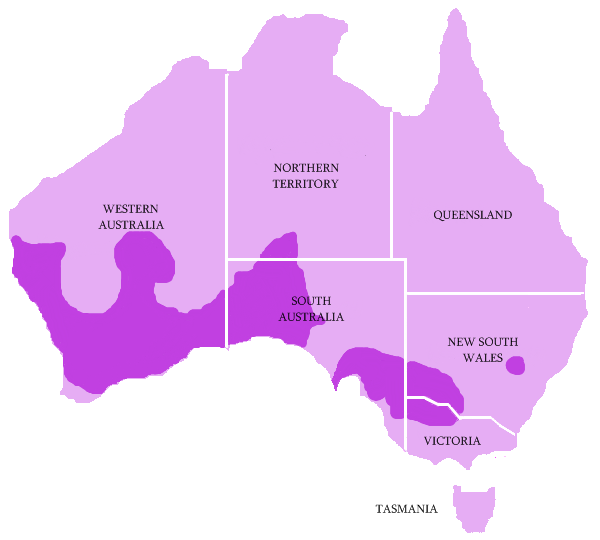
The Western Blue Tongue Lizard (Tiliqua Fasciata) lives in Central Australia and along the coast of Western Australia.
 |
| Image 4 |
Western Blue Tongue Lizard
 |
| Image 5 |
The Western Blue Tongue Lizard (Tiliqua Occupitalus) lives along the South Western coast of Western and Southern Australia.
 |
| Image 6 |
Shingleback Lizard
 |
| Image 7 |
The Shingleback Lizard (Tiliqua Rugosa) is found in Southern Western Australia as well as most of Southern Australia and New South Wales.
 |
| Image 8 |
Conservation
Blue Tongues all across Australia are in decline for several reasons:
- Domesticated and feral animal attacks
- Blue Tongues have short and stumpy legs and are unable to run away
- Blue Tongues open up their mouths and show off their blue tongue to scare away predators
- Dogs are normally fooled (if only temporarily)
- Cats are not fooled and will continue to attack
- Lawn Mowing
- It is commonplace to find a blue tongue lizard in your yard when you are mowing, but the blue tongues will not run away when they hear the lawnmower- instead choosing to fight it
- Insecticides
- Blue Tongues love snails! They will not leave one alone if they see it.
- Because of snail poisons, blue tongues commonly eat poisoned snails and die.
- Avoid using snail poison in your backyard- the snail population will recover but the blue tongue population will not!
- As well as loving snails, blue tongues also love strawberries!
- They will eat any strawberry, whether it is ripe or not!
- Because of poisons sprayed on plants, the blue tongues can also die from poisoned strawberries.
You can help save blue tongues by:
- Keeping your pets inside
- Walking pets on leashes
- Leaving blue tongues alone if you see one on the ground
- Not using insecticides! The blue tongues can keep the snail population under control just fine if you don't kill them!
Subscribe to:
Posts (Atom)